Shipping container twist locks are the mechanical fasteners that keep containers secure during transport, stacking, and structural applications. Whether you’re stacking containers on your property, transporting them on a chassis, or simply preventing theft and wind displacement, understanding twist locks ensures your container stays exactly where you need it.
This blog explains what twist locks are, which types work for different applications, and how to use them correctly for maximum safety and stability. If you’re buying a container for permanent storage, temporary placement, or transport, twist locks may be the critical hardware component you didn’t know you needed.
What Are Shipping Container Twist Locks?
Twist locks are specialized locking devices that engage with the corner castings on shipping containers. Each container has eight corner castings, four on top, four on bottom, with standardized oval holes designed to accept twist lock cones.
How Twist Locks Work
The mechanism is elegantly simple:
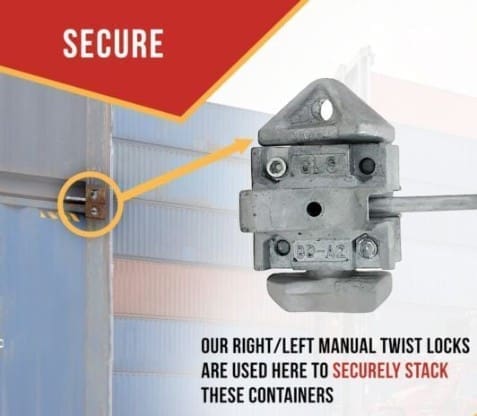
- Insert the cone-shaped head into the corner casting’s oval aperture
- Rotate the lock 90 degrees using the attached handle or tool
- The cone rotates inside the casting, locking into position
- The container is now mechanically secured and cannot separate
This rotating action creates a positive lock that resists vertical and horizontal forces. Twist locks can typically handle 60,000+ lbs. of load when properly installed.
Who Invented Shipping Container Twist Locks?
Engineer Keith Tantlinger revolutionized the shipping industry in the 1950s when he developed twist locks while working alongside shipping pioneer Malcolm McLean. His rotating cone mechanism addressed a major challenge facing the new intermodal container system: securely stacking standardized steel containers without requiring specialized hardware for each unit. This innovation, combined with standardized corner castings, laid the foundation for modern global shipping.
Why Twist Locks Matter
- Safety: Prevents containers from shifting, sliding, or toppling during transport or stacking.
- Stability: Secures stacked containers against wind loads and seismic movement.
- Security: Deters theft by mechanically anchoring containers to foundations or ground plates.
- Legal Compliance: Required by DOT regulations for over-the-road container transport.
- Insurance: Many commercial insurance policies require proper securing methods for stacked containers.
Who Needs Shipping Container Twist Locks and Anchors?
This analysis targets buyers who need to understand twist lock applications:
- Homeowners: Securing containers on residential properties, especially in areas with high winds or theft concerns.
- Contractors: Stacking containers on job sites for vertical storage or transporting containers between locations.
- Businesses: Creating multi-level container storage facilities or securing inventory containers in open yards.
- Anyone Stacking Containers: Understanding proper locking mechanisms prevents accidents, injuries, and property damage.
Types of Twist Locks: Choosing the Right Hardware
Not all twist locks serve the same purpose. The right type depends on whether you’re stacking, transporting, or anchoring containers.
Manual Twist Locks (Stackers)
What they are: Simple mechanical locks operated by hand, used to connect two containers vertically.
How they work: Install on the top corner castings of the lower container. The upper container’s bottom castings sit on the twist lock cones, then you rotate the lock 90 degrees to secure.
Best for:

- Stacking two or more containers on your property
- Job sites requiring vertical storage expansion
- Warehouse yards with multi-level container storage
Benefits:
- Cost-effective
- Easy installation
- Reusable
- Strong load capacity
Quantity needed: 4 locks per connection point (one at each corner where containers meet)
Semi-Automatic Twist Locks
What they are: Spring-loaded locks that engage automatically when containers are lowered onto them but require manual unlocking.
How they work: Install on the lower container’s top castings. When the upper container is placed, its weight triggers the lock to automatically rotate and engage. Unlocking requires manual rotation.
Best for:

- Frequent stacking/unstacking operations
- Mounting containers to flat surfaces
- Crane operations where manual locking from height is impractical
- Commercial facilities with regular container movements
Quantity needed: 4 locks per connection point
Benefits:
- Faster handling in high-volume environments
- Reliable locking under heavy loads
Fully Automatic Twist Locks
What they are: Advanced locks that automatically engage when containers stack and automatically release when lifted—no manual operation.
How they work: Gravity and lift forces trigger both locking and unlocking. Crane pressure releases the lock; container weight engages it.
Best for:
- High-volume shipping terminals
- Intermodal facilities with rapid container turnover
- Professional transport operations
Quantity needed: 4 locks per connection point
Bridge Fittings (Chassis Locks)
What they are: Specialized twist locks mounted on truck chassis or trailers to secure containers during road transport.
How they work: Permanently or semi-permanently mounted to the chassis bed. Container is lowered onto the fittings, then twist locks rotate to secure bottom corner castings.
Best for:
- Over-the-road container transport
- Moving containers between properties
- Contractors transporting job site storage units
Quantity needed: 4 locks (one at each chassis corner)
Ground Anchor Tie Downs
What they are: Secures your shipping container with ease using our high-quality shipping container anchors.
How they work: Bolted or embedded into concrete. Multi-functional shipping containers side twist lock fit for various standard containers, making it easy to disassemble and install.
Best for:

- Permanent container installations
- High-wind coastal areas (hurricane zones)
- Theft prevention in open storage yards
- Container conversions requiring building code compliance
Quantity needed: 4 plates (one per container corner)
Twist Lock Comparison: Choosing the Right Type
Twist Lock Type | Best Use Case | Manual Operation? | Cost per Lock | Typical Application |
Manual Twist Lock | Property stacking | Yes (lock & unlock) | $40-$56 | Homeowners, contractors |
Semi-Automatic | Frequent stacking | Yes (unlock only) | $50-$80 | Commercial yards |
Fully Automatic | High-volume operations | No | $50-$150+ | Shipping terminals |
Bridge Fittings | Road transport | Yes | $50-$100 | Chassis/trailer mounting |
Foundation Anchors | Permanent placement | Yes | $50-$120 | Wind zones, security |
Do You Need Twist Locks for Ground Storage?
If you’re placing a single container on your property, standard stacking twist locks aren’t required but foundation anchor plates are a smart investment. These ground anchoring systems mechanically lock your container to concrete, preventing theft and wind displacement. For storage in open yards, high-wind areas, or properties with security concerns, anchoring is essential protection.
When Twist Locks Are Recommended
- High-Wind Areas: Coastal regions, tornado zones, or open plains where sustained winds exceed 50 mph. Empty containers can shift or tumble in extreme wind events.
- Theft Prevention: Open storage yards, construction sites, or properties with high theft risk. Twist locks anchored to concrete make containers nearly impossible to steal without heavy equipment.
- Sloped Sites: Properties with grades exceeding 5 degrees where containers might slowly shift over time due to gravity and freeze-thaw cycles.
- Building Code Requirements: Some municipalities require mechanical anchoring for container conversions or permanent structures.
When Twist Locks Are Optional
- Level, Protected Sites: Residential backyards on flat ground with natural windbreaks (trees, fences, buildings).
- Heavy, Loaded Containers: Once a container holds several thousand pounds of contents, wind displacement becomes negligible.
- Low-Risk Areas: Properties with secure fencing and low crime rates where theft isn’t a concern.
How to Install Twist Locks for Container Stacking
Proper installation ensures safety and prevents accidents when stacking containers.
Step-by-Step Installation Process
- Step 1: Ensure Lower Container is Level– Use a carpenter’s level to verify the lower container sits flat. Even slight tilts can cause upper containers to shift over time.
- Step 2: Clean Corner Castings– Remove dirt, rust, or debris from top corner castings on the lower container. Contamination prevents proper lock engagement.
- Step 3: Install Twist Lock– Insert manual or semi-automatic twist locks into all four top corner castings of the lower container. Ensure they rotate freely.
- Step 4: Position Upper Container– Use a crane, forklift, or boom truck to carefully lower the upper container. Align bottom corner castings with twist lock cones.
- Step 5: Engage Locks– For manual locks: Once upper container rests on cones, rotate each lock 90 degrees clockwise. For semi-automatic: Locks engage automatically when weight is applied.
- Step 6: Verify Secure Connection– Visually inspect each corner. All four locks should be fully rotated. Test by gently rocking the upper container—no movement should occur.
Safety Precautions
- Never climb on stacked containers without proper fall protection. Use scaffolding, lifts, or ladders with harnesses when accessing heights.
- Never stack more than two containers without engineering approval. Three-high stacking requires structural calculations and additional bracing.
- Inspect twist locks annually. Check for rust, cracks, or worn components. Replace any damaged locks immediately.
When to Consult a Structural Engineer
While simple two-high stacking with twist locks is generally safe for homeowners and contractors, some scenarios require professional engineering:
- Three or More Containers High: Requires load calculations, wind analysis, and potentially additional bracing.
- Commercial Multi-Story Structures: Container offices, apartments, or retail buildings need engineered drawings and building permits.
- Seismic Zones: High earthquake risk areas may require additional anchoring beyond standard twist locks.
- Modified Containers: Cutting large openings (windows, doors, walkways) compromises structural integrity—engineer must verify stacking safety.
Where to Buy Twist Locks for Shipping Containers
Choosing a reputable supplier ensures you receive genuine twist locks that meet safety standards and perform reliably under heavy loads.
Buy Twist Locks from Container Sales Group
Container Sales Group carries a full range of twist locks, foundation anchors, and container security hardware for stacking, transport, and permanent installations. With over 25 years serving contractors, businesses, and homeowners nationwide, we supply only quality-tested locking mechanisms that comply with ISO and DOT specifications.
Why buy from Container Sales Group:
- Quality-tested locks that meet safety standards
- Expert guidance on selecting the right lock type
- Trusted by Fortune 500 companies and contractors
Browse Container Locks & Twist Locks →
Frequently Asked Questions
Do I need twist locks for one container sitting alone?
No. Twist locks are primarily needed when stacking or securing to a chassis or foundation.
Can I stack containers without twist locks?
No. Stacking containers without twist locks is dangerous and violates safety standards. Even minor wind loads or seismic activity can cause upper containers to shift and fall, causing injury or property damage.
Can containers be welded together instead?
Welding is possible but not recommended without structural engineering review.
Can I install twist locks myself?
Manual stacking locks are simple to install but must be placed correctly.
What’s the difference between manual and automatic twist locks?
Manual twist locks require hand operation to lock and unlock. Semi-automatic locks engage automatically when containers stack but need manual unlocking. Fully automatic locks require no manual operation—they engage and release automatically. Manual locks are most affordable for homeowners and contractors; automatic locks suit high-volume commercial operations.
Are twist locks required by law?
Yes, for over-the-road transport. DOT regulations require containers be properly secured to chassis using twist locks or equivalent restraints. For ground storage, local building codes may require anchoring in high-wind zones or for permanent structures, but requirements vary by jurisdiction.