
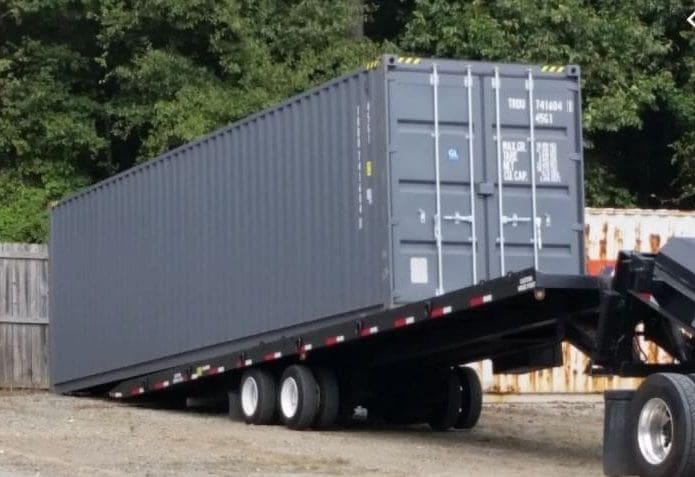
Shipping container delivery day does not always go as planned and today gave us a clear example why. One of our drivers arrived at a job site with an empty 40 ft container loaded on the tilt body truck and could not get it off the truck. The driveway looked wide enough on paper, but a fence post and an overhanging tree branch left no room to maneuver. The truck turned around, and the customer is now facing a dry-run fee, a return freight charge, and a new re-delivery date with freight charge. Here is exactly what went wrong, what it costs when a container delivery day fails, and the numbers you need so it does not happen to you.
Why a Shipping Container Delivery Day Can Go Wrong at the Curb
A container delivery day goes wrong most often because of obstacles a driver cannot see until the truck is already on-site. What looks like plenty of room from the sidewalk is rarely enough room for a loaded tractor-trailer swinging a 20 ft or 40 ft container into position. The most common surprises include:
- A fence line, mailbox, or utility box sitting closer to the driveway than it appears from the street.
- A low-hanging tree branch or power line that clears a car but not a raised trailer bed.
- Parked vehicles narrowing a residential street so the rig cannot complete its swing.
- Soft, sloped, or uneven ground that was never tested for a fully loaded truck.
None of these are visible in a quick walk-outside-and-eyeball-it check. They only show up once a driver is committed to the approach, which is exactly why they cause the most delivery failures.
What Happens Financially After a Failed Container Delivery Day
When a container delivery day fails, the costs fall into three categories: the dry-run fee, the return and storage charge, and whatever refund or exchange terms apply from there. A dry-run fee is what a delivery company charges when a truck is dispatched but the container is never actually dropped off, usually because the site was not ready when the driver arrived. The truck still made the trip, and the driver still did the work, so that cost gets passed back to the customer instead of absorbed by the carrier.
- The Dry-Run Fee: Covers the driver’s time, fuel, and labor for the attempted delivery, typically $250 to $1,000 or more depending on distance from the depot.
- Return and Storage Costs: The container goes back to the depot or a local yard. You pay the return freight cost plus in some cases an in-gate fee until a new plan is set.
- Refunds, Exchanges, and Cancellations: Two outcomes are most common.
- Cancel the order and your refund is issued minus the original delivery fee, the dry-run fee, the return freight cost, and any in-gate or restocking charges.
- Exchange for a smaller container, such as swapping a 40 ft container for a 20 ft container, and you pay the re-delivery fee plus or minus any price difference in the equipment.
This is exactly why our delivery terms and conditions require a ready site before a truck is dispatched. Every New or Used Container we sell is still backed by our Wind & Water Tight Guarantee, but that guarantee covers the container’s condition, not the added freight and fees from a failed delivery attempt.
How Much Room Does a Container Delivery Day Really Need
A container delivery day requires far more clearance than a tape measure check of the parking spot. Full site readiness covers straight-line distance, overhead swing height, the truck’s turning apron, and the ground’s ability to bear a fully loaded rig. Standard container dimensions only tell you the size of the box, not the space needed to set it down.
- Straight-Line Clearance: 60 to 70 feet in front of the drop spot for a 20 ft container, 100 to 120 feet for a 40 ft container.
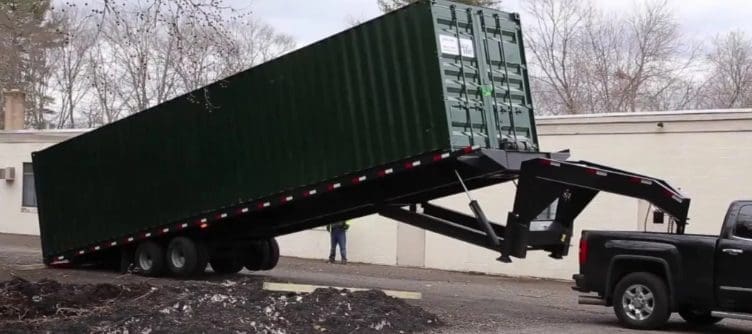
- Overhead Swing Height: Containers sit 8.5 to 9.5 feet tall on the ground, but the top edge can reach 13 feet 6 inches to 16 feet into the air while sliding off a tilted trailer.
- Turning Apron: A tractor-trailer needs at least 35 to 40 feet of road width to swing into a standard driveway or gate opening.
- Ground Bearing Capacity: The surface must hold a loaded truck weighing 30,000 to 45,000 pounds or more without sinking, well within the commercial vehicle weight standards that govern how these trucks are loaded and operated.
A container delivery day that accounts for all four numbers, not just length and width, is far less likely to end in a dry-run fee.
How to Set Up Your Site Before Container Delivery Day
The best way to guarantee a smooth container delivery day is to document your site before the truck is scheduled, using the checklist in our Container Delivery & Site Preparation guide.
- Record a Video of the Path: Walk from the main road to the final drop spot and capture gate widths, turns, overhead wires, and ground conditions.
- Send It to Dispatch in Advance: Share the video, photos, and pin location with the logistics team before delivery day so a driver or site evaluation can catch problems early.
- Read Your Delivery Terms: Know your responsibilities for site preparation, since this is what determines whether a dry-run fee applies.
Avoiding a failed container delivery day comes down to a few minutes of preparation against a truck that cannot turn around once it commits to your driveway.
Why Container Sales Group Leads In Successful Deliveries
Since 1998, Container Sales Group has delivered wholesale pricing through direct relationships with shipping lines. Here’s what sets us apart.
- Direct Sourcing: We buy directly from depots and steamship lines, cutting out broker markups.
- Condition Transparency: Every container is graded and photographed honestly before it ships.
- Real People Answer the Phone (888-320-5938): No call centers, no chatbots, no automated loops.
- Delivery Options: Nationwide delivery with local support in Illinois, Wisconsin, and Indiana.
- WBENC-Certified Women-Owned: Independently verified for accountability.
- 550+ Five-Star Google Reviews: A track record customers can check for themselves.
Ready to find the right container for your delivery project? Call us at (888) 320-5938 or request a quote online. We will make it an easy and straightforward experience.